
History of Spectral Imaging: Pioneering Discoveries and Applications
Spectral imaging has the power to reveal what the human eye cannot see, from detecting hidden contaminants in food to identifying mineral compositions in space. This extraordinary capability has driven progress across industries, solving challenges that once seemed insurmountable.
Tracing the history of spectral imaging unveils a journey of scientific breakthroughs and innovation. In this article, we’ll explore how this transformative technology emerged, evolved, and continues to revolutionise fields like mining, agriculture, and environmental monitoring.
What is Spectral Imaging?
Spectral imaging combines imaging and spectroscopy to capture data across different wavelengths of the electromagnetic spectrum. Developed in the mid-20th century, this technology enables detailed analysis of objects and materials, offering insights invisible to the human eye.
The History of Spectral Imaging
Spectral imaging traces its origins to the 19th century, when Joseph von Fraunhofer discovered spectroscopy and began studying light’s interaction with matter. Early advancements in spectrometry laid the foundation for combining spectral data with imaging.
The 1970s marked a significant leap with the development of hyperspectral imaging systems. Capturing data across hundreds of spectral bands, these systems were initially applied in remote sensing and astronomy, allowing scientists to study Earth and space with unprecedented detail.
By the 1990s, advancements in processing power and compact device design made spectral imaging more accessible. Industries like agriculture, healthcare, and manufacturing adopted it for applications such as crop monitoring, medical diagnostics, and quality control.
- Interesting Fact: In the 1970s, NASA developed AVIRIS (Airborne Visible/Infrared Imaging Spectrometer), a pioneering hyperspectral imaging technology. This innovation transformed Earth observation, enabling detailed remote sensing for environmental monitoring—Learn More Here
Key Developments in the history of Spectral Imaging
- 19th century: Discovery of spectroscopy by Joseph von Fraunhofer.
- 1970s: NASA develops hyperspectral imaging for Earth and space exploration.
- 1980s: Imaging and spectroscopy merge to enable practical applications.
- 1990s: Compact systems make spectral imaging more widely available.
- Today: Advanced systems enable real-time analysis and broader applications.
In Focus: How Remote Sensing is Transforming Industry Applications
Remote sensing, often referred to as airborne hyperspectral imaging, uses spectral imaging to gather detailed compositional information over large areas.
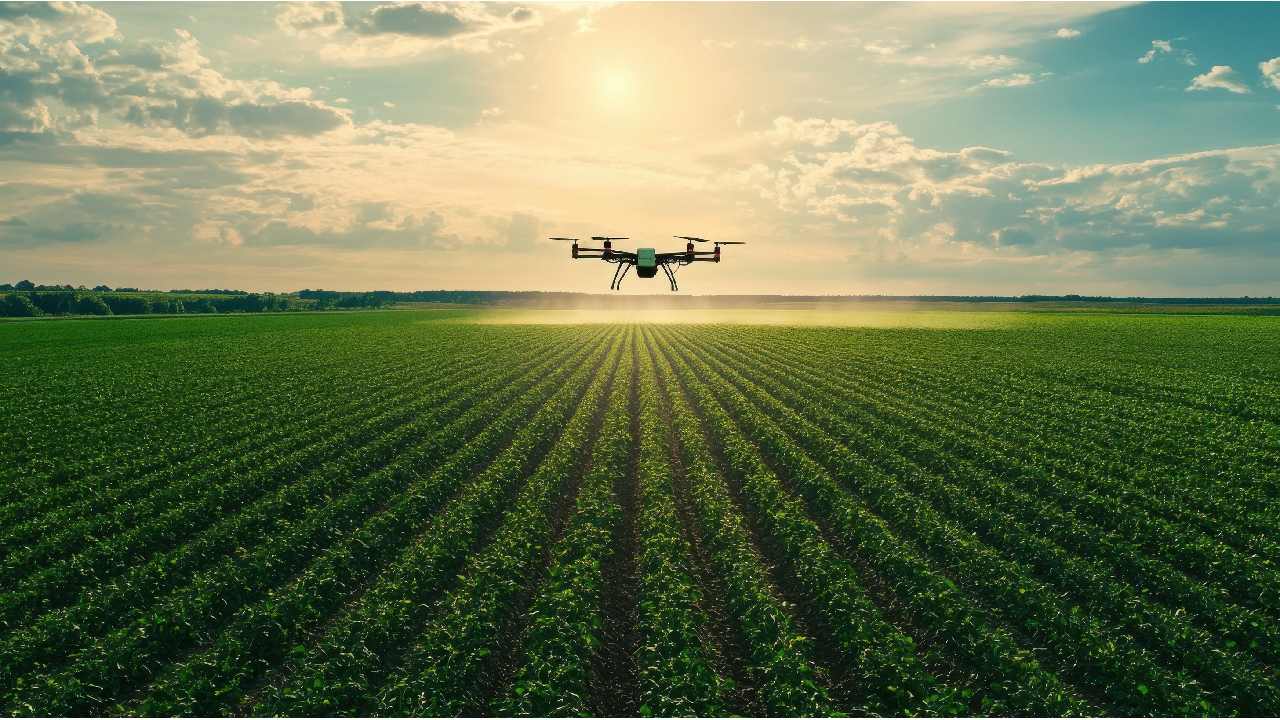
By employing high-resolution imaging from aerial platforms like drones, it can rapidly map vast landscapes. Coupled with advanced spectral analysis, this method reveals chemical and geological structures beyond the visible spectrum.
Here are a few ways remote sensing drives industry innovation:
- Agricultural Operations: Enables precision farming by analysing crop health, soil quality, and nutrient levels without damaging produce, increasing yield and sustainability. Learn more about precision agriculture here.
- Mining Exploration: Identifies mineral composition, deposit size, and value more accurately and safely using UAV-mounted sensors, optimising extraction planning and reducing costs. Learn more about mine mapping here.
- Environmental Monitoring: Tracks ecosystem health, detects invasive species, and monitors forests and coastal regions, providing vital insights for preservation and sustainability. Learn more about its environmental applications here.
These examples demonstrate how remote sensing, powered by spectral imaging, has become indispensable across industries. Its ability to deliver precise, actionable data at scale is transforming agriculture, mining, and environmental preservation, paving the way for smarter, more sustainable practices.
- Interesting Fact: Interesting Fact: Remote sensing has been crucial in tracking coral bleaching on the Great Barrier Reef. Satellites like ESA’s Sentinel-2 analyse spectral data to detect coral health changes, offering vital insights into the effects of rising sea temperatures on this iconic ecosystem—Learn More Here
Other Modern Applications of Spectral Imaging
Spectral imaging has become indispensable across industries, solving complex challenges with precision. Key applications include:
- Healthcare: Enhances imaging for early disease detection and diagnosis.
- Manufacturing: Ensures product consistency and detects defects.
- Security and Defence: Supports surveillance and material identification.
Could Spectral Imaging Benefit Your Operations?
The history of spectral imaging highlights its transformative impact on modern industries. From improving quality control to advancing scientific research, it’s a technology that continues to drive innovation.
Would you like to explore how spectral imaging can empower your business? Contact Portable Analytical Solutions today to discover how this cutting-edge technology can provide precise, actionable insights for your operations.
Sources: Britannica ; NASA ; ESA ; Wiki