

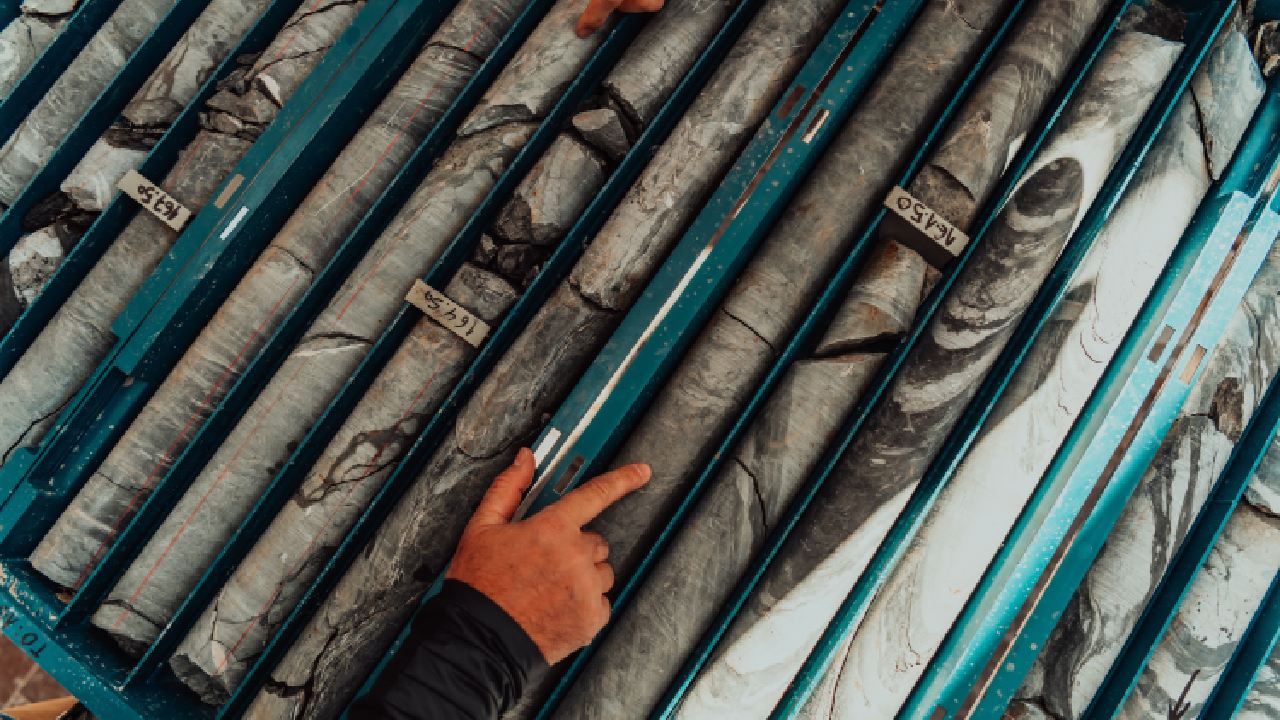
When a portable reading in the field doesn’t match what the lab reports later, the instinct is to question the instrument. A peer-reviewed review of handheld XRF use in field geology, including work informing planetary surface exploration, found that how a sample was prepared and presented before scanning was consistently what limited data quality and interpretation, more so than the instrument’s own performance (ScienceDirect).
The same pattern shows up in reflectance spectroscopy. The analyser itself is usually fine. What varies from one reading to the next is everything around it: how the sample was positioned, how far it sat from the sensor, what the light was doing at the time, and whether today’s scan was taken the same way as last week’s.
For exploration and mine-site teams using field NIR and SWIR reflectance spectroscopy to vector alteration mineralogy, that distinction is not academic. It is the difference between data you can use to place the next hole and data you end up quietly discounting once you notice it does not agree with itself.
Sample Presentation Does More Damage Than People Expect
Researchers examining portable XRF performance on minerals and loose geological materials found that particle size, porosity and moisture shift a reading away from a laboratory result, even when the instrument’s own settings are correct and nothing about the analytical method has gone wrong (Minerals, MDPI).
The sample itself, not the sensor, is where most of the disagreement comes from. A rock chip measured against the fibre optic at one angle and distance will not necessarily reproduce a reading taken from the same chip five minutes later at a slightly different angle, and a hand sample scanned wet will not spectrally resemble the same sample scanned dry.
For teams already running a portable XRF programme alongside NIR, this is a useful reminder that the two techniques answer different questions and carry different presentation sensitivities. A Guide to Portable XRF Geochemistry in Mining covers how elemental data fits into a broader exploration geochemistry programme, which is a useful companion to the mineralogical picture NIR provides.
The Same Discipline Applies to Reflectance Measurements
Reflectance spectroscopy has its own version of this problem, and field practitioners have documented it directly. One widely used field protocol for canopy and target reflectance calls for a white reference measurement immediately before a set of readings, followed by a second reference measurement afterwards as a check. If the two reference readings differ by more than a small margin, the intervening measurements are treated as unreliable, because it means the illumination changed partway through (2Excel Geo).
The same logic applies to a drill core tray scanned under a fixed light source or an outcrop scanned in variable daylight. Without a consistent, checkable reference, there is no way to know afterwards whether a spectral shift reflects a change in the rock or a change in the light.
This is also where the distinction between contact and non-contact measurement geometry starts to matter in practice. A contact measurement removes ambient light from the equation entirely, at the cost of needing consistent physical contact with the sample. A non-contact measurement is faster across a chip tray but reintroduces distance and angle as variables. Neither approach is wrong.
What matters is knowing which one you are running and controlling for its particular failure mode. For readers who want the fundamentals of how NIR compares to laboratory analysis in the first place, Is There an Alternative to Mineral Analysis Laboratories? Introducing Portable NIR is a good starting point.
Why the Margin for Error Is Shrinking
None of this is new to experienced field geologists, but the tolerance for inconsistent data is narrowing. JORC’s most recent update on its Code review, presented at a webinar on 20 August 2026, confirms the legal review of the first full revision to the Australasian Code for Reporting of Exploration Results, Mineral Resources and Ore Reserves since 2012 is now in its final stages, with the Code, Table 1 and Guidance Notes targeted for finalisation in the second half of 2026 ahead of CRIRSCO, ASX and ASIC review (JORC).
Among the changes flagged is a sharper definition of a Competent Person’s responsibility for the documentation supporting a Public Report, alongside a new Record of Relevant Experience requirement for Competent Persons, itself still under legal review.
That raises the practical bar for field programmes.
Data that supported a resource estimate five years ago on the strength of a geologist’s experience now needs to stand up to closer questioning about method, not just outcome. A measurement taken with a fixed, repeatable geometry and a documented calibration check is far easier to defend than one that relied on whoever was holding the probe that day.
Built for the Problem: The Spectral Evolution Range
Portable Analytical Solutions is the Australian distributor for Spectral Evolution, and the manufacturer’s geology and mining spectrometer range covers the field-portable and laboratory spectroradiometers that sit behind a lot of this workflow. What often gets less attention is that the accessory chosen for a given task usually decides whether the presentation problem above is solved or reintroduced.
For readers who want the broader case for why field NIR mineralogy matters to an exploration programme in the first place, Australia Is Drilling More Than Ever, So Why Aren’t We Finding More? The Case for Mineralogy at the Drill Site covers that ground. This piece is about what happens once you have decided to run field spectroscopy and need the data to actually be trustworthy.
A few examples of how specific accessories map onto specific failure modes:
- Contact Probe (Standard and Miniprobe): fixes the spot size (10mm or 3mm) and geometry against the sample, with the standard probe’s sapphire window keeping ambient light out entirely. This addresses the angle-and-distance variability that comes with holding a probe freehand.
- Benchtop Reflectance Probe: gives loose or particulate material, drill chips, pulps, soils, a standardised chamber and a reusable quartz window rather than an open bench surface, which is exactly the particle-size and presentation sensitivity the MDPI research points to.
- Pistol Grip Fiber Holder: standardises how a non-contact reading is held and triggered, reducing the operator-to-operator variability that shows up when several people are running the same instrument across a shift.
- Field of View Lenses: fix the target framing at a given distance, so a non-contact scan of a rock face or chip tray is measuring a consistent area rather than whatever falls within an uncontrolled cone.
- Reflectance Panels and the ILM series light sources: provide the white reference and consistent illumination that the field spectroscopy protocol above depends on, with an Easy-Mount Tripod to hold the panel and pistol grip in a fixed position rather than propped against whatever is nearby.
- Fiber Optic Cables: field-replaceable and ruggedised in stainless steel, so a damaged cable can be swapped on site rather than the whole instrument being sent away mid-programme.
None of this replaces sound technique. It removes some of the ways technique can quietly drift over a long field season.
Built for the Conditions, Not Just the Bench
The ABS’s June quarter 2026 release, published 31 August 2026, shows mineral exploration expenditure reaching $1,189.8 million for the quarter, the highest quarterly figure in the ABS series back to at least 2018, up 24.8% on the March quarter. Metres drilled rose 29.1% over the same period, to 3,461.6km (Australian Bureau of Statistics).
More metres drilled means more instrument-days in the field, and more instrument-days means more exposure to dust, heat, transport and general handling.
This is where the less glamorous accessories earn their place. A Pelican case protects the instrument and its accessories in transit between sites. A custom-fit backpack keeps the same kit organised and carryable across a full day’s traverse. A rugged, IP65-rated tablet with GPS keeps data collection functional in conditions that would put a standard laptop out of action within a season.
None of these change what the spectrometer measures. They change how many field days the whole setup survives before something needs replacing, which has its own bearing on how consistent a season’s data ends up being.
The Accessory Is Part of the Method
The research on field spectroscopy keeps landing in the same place: the instrument is rarely the weak point, and the way a sample is presented, lit and handled usually is. As reporting standards tighten and exploration budgets push more teams into genuinely new ground, that distinction matters more than it used to.
Choosing the right contact probe, reflectance panel or field case is not an afterthought once the spectrometer is bought. It is part of how the measurement is actually made.
If you would like to talk through which accessories suit your program, or which instrument in the Spectral Evolution geology and mining range fits your fieldwork, get in touch with the PAS team. We also offer manufacturer-accredited training on the full accessory range.
Sources: